Agentic AI: What It Is and What It Changes for Your Company
What agentic AI is, how it differs from generative AI, how it works, how much autonomy to give it and where to start. Explained for companies, without jargon.

Agentic AI is artificial intelligence that acts instead of only answering: it takes a goal, plans the steps, uses tools to complete them, checks the result and asks a person for approval when something matters. If generative AI writes a text when you ask, agentic AI finishes a job.
The term gets used for almost anything. Here we bring it down to a small or mid-sized company: how it works, where it fits and how much autonomy it makes sense to give it.
In 30 seconds
- What it is: AI systems that chain steps and use tools to reach a goal.
- How it differs from generative AI: generative AI produces content when asked; agentic AI acts and finishes tasks.
- The basic building block: the AI agent. Agentic AI is the way of working with one or several coordinated agents.
- The important decision: which decisions always stay with a person.
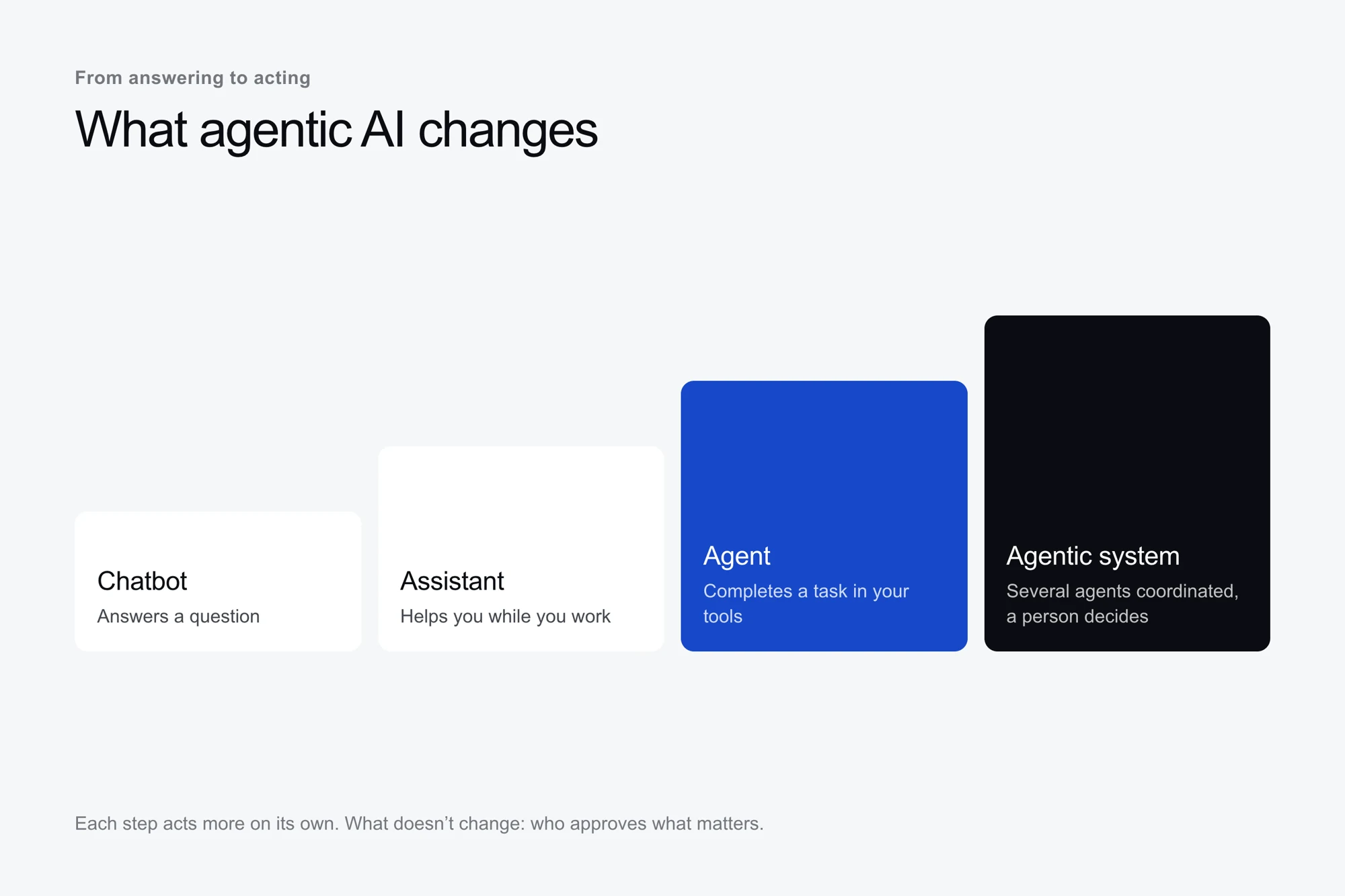
Agentic AI and generative AI: the difference
Plenty of companies already use generative AI: someone asks for a draft email, a summary or an idea, and the AI writes it. It’s useful, but the work is still the person’s: copy the result, paste it into another tool, check it and carry on.
Agentic AI does that work inside your tools:
| Generative AI | Agentic AI | |
|---|---|---|
| What it receives | A specific request | A goal |
| What it does | Produces text, an image or a summary | Plans steps, uses tools and completes the task |
| Where it works | In a separate window | Inside your email, CRM or invoicing software |
| Who follows the process | The person, step by step | The system, with a person approving what matters |
| Example | ”Draft a reply to this customer" | "Answer order-status questions and pass complaints to me” |
Inside, there’s still a language model that understands and writes. What changes is everything built around it so it can act with permissions, rules and oversight.
How an agentic system works
Inside, any agentic system repeats the same loop:
- Receives a goal. For example: “book the supplier invoices that arrive by email”.
- Plans the steps. Open the attachment, read the data, find the order, compare, book.
- Uses your tools. With limited permissions: email, accounting software, the orders folder.
- Checks the result. Does the amount match? Is anything missing? If it isn’t right, it plans again.
- Asks for approval if it matters. Anything with consequences, like a payment or a change with a customer, goes through a person.
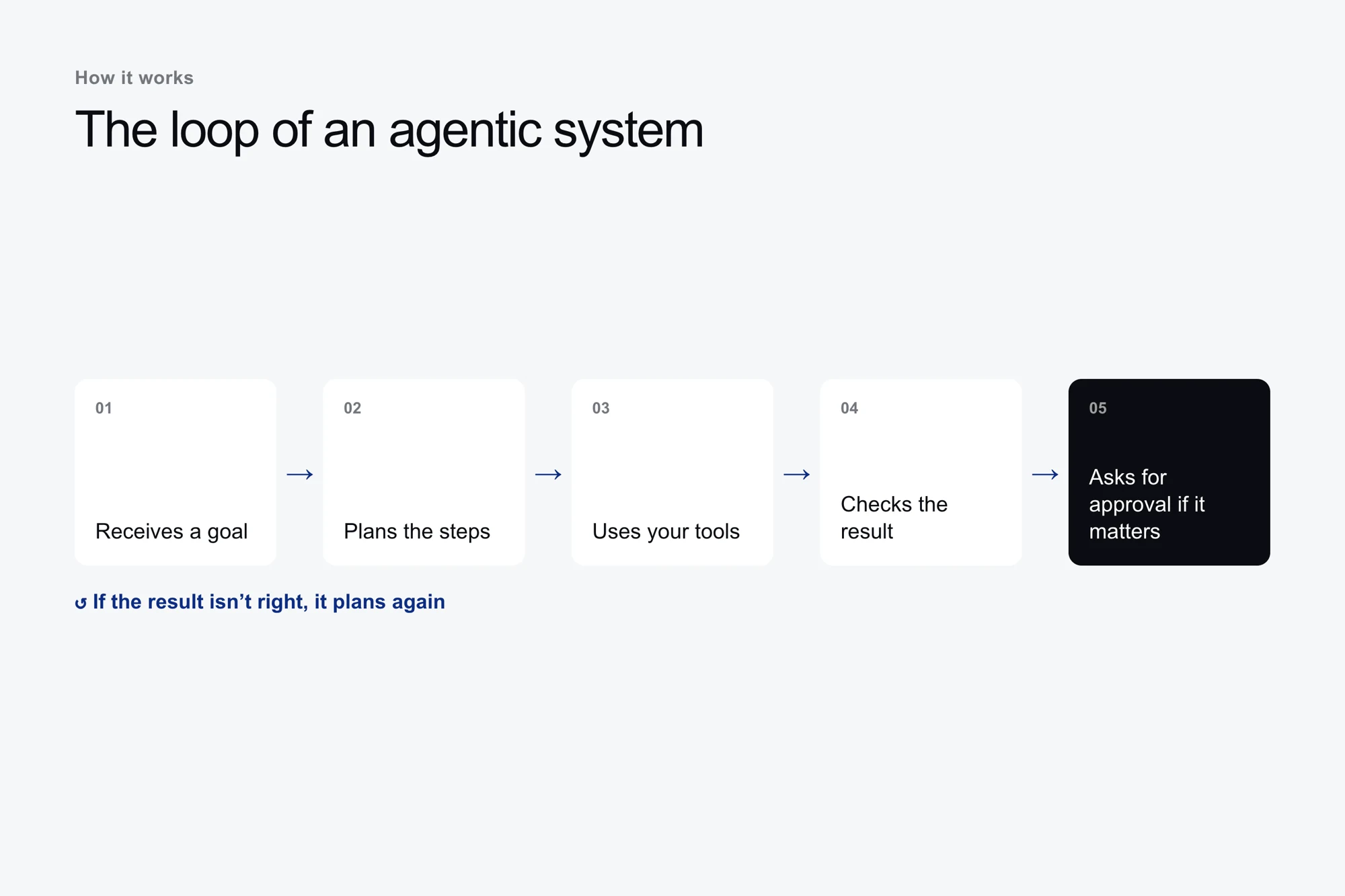
The last step is the one that matters. When a well-designed system hits something it doesn’t understand, it flags it and hands it to a person with the context.
Examples of agentic AI in a company
In small and mid-sized companies, agentic AI usually starts with repetitive processes involving documents and messages:
- Finance and admin: supplier invoices are read, matched to the order and booked on their own; your team reviews only the ones that don’t match. More in finance and admin.
- Sales: every quote request becomes a complete record and a draft with your template; you approve price and sending. More in sales.
- Operations: orders that arrive across several messages are merged into one and supplier delays are caught before they reach the customer. More in operations.
- Customer service: the usual questions are answered with your information and the hard ones reach your team with the history and a draft. More in customer service.
In all four, the system does the repetitive work end to end and the person keeps the decisions.
How much autonomy to give agentic AI
Autonomy is decided per type of decision, depending on risk. Answering a repeated question and approving a payment don’t deserve the same treatment.
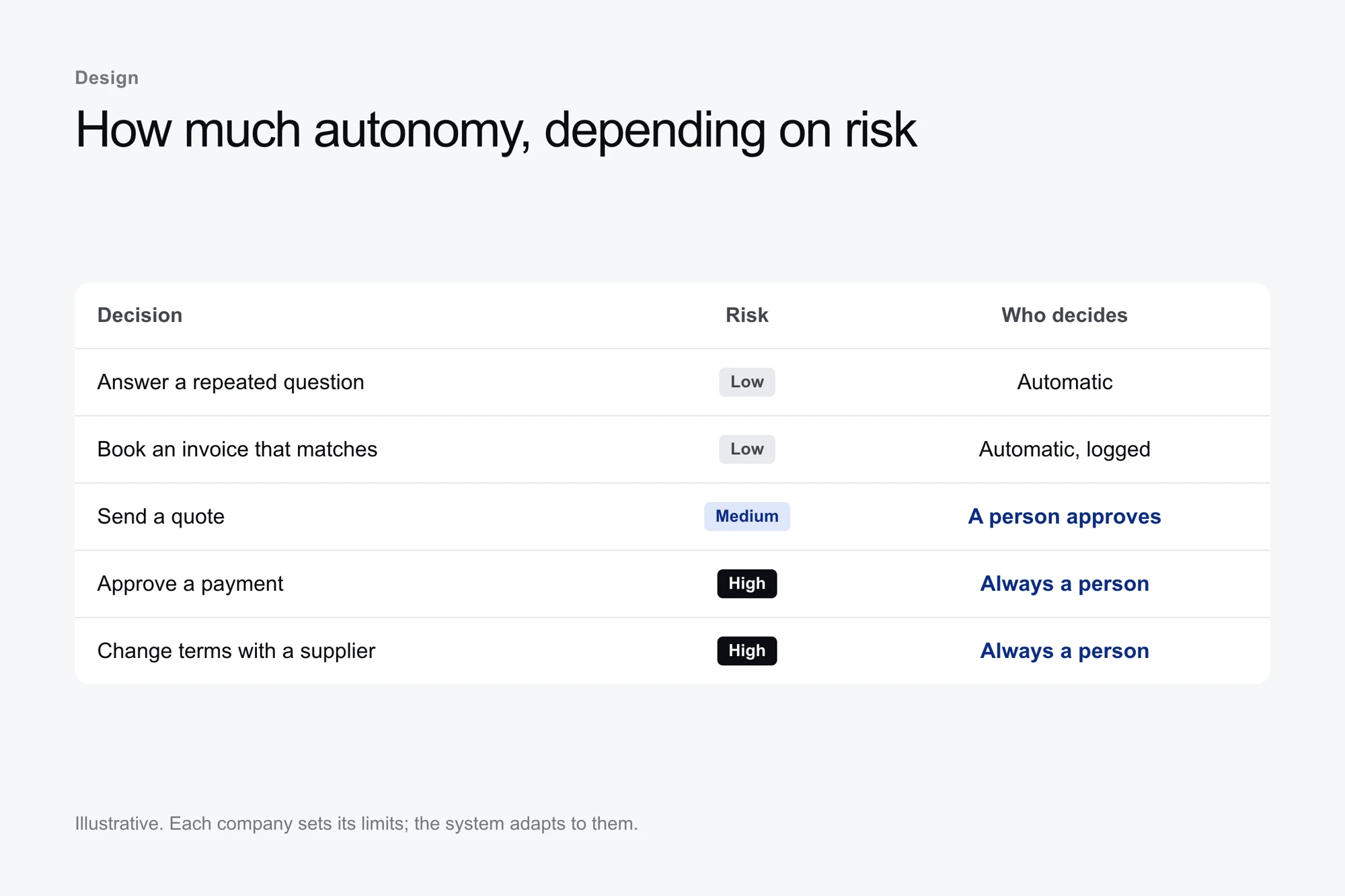
Three rules we always apply:
- Start with approval on everything and loosen gradually. Autonomy is earned with data: when a type of task has gone weeks without corrections, it can be fully automated.
- Anything involving money or commitments always goes through a person. Payments, prices, terms and anything leaving the company.
- Everything is logged and can be paused. If something isn’t going well, it’s visible and can be stopped without depending on anyone.
Where agentic AI is heading
Analysts agree on the direction, and on the risk:
- Gartner predicts that by 2028, 15% of day-to-day work decisions will be made autonomously through agentic AI, up from 0% in 2024 (Gartner).
- It also estimates that by 2026, 40% of enterprise applications will feature task-specific AI agents, up from less than 5% in 2025 (Gartner).
- And it warns that over 40% of agentic AI projects will be cancelled by the end of 2027 because of costs, unclear value or inadequate risk controls (Gartner).
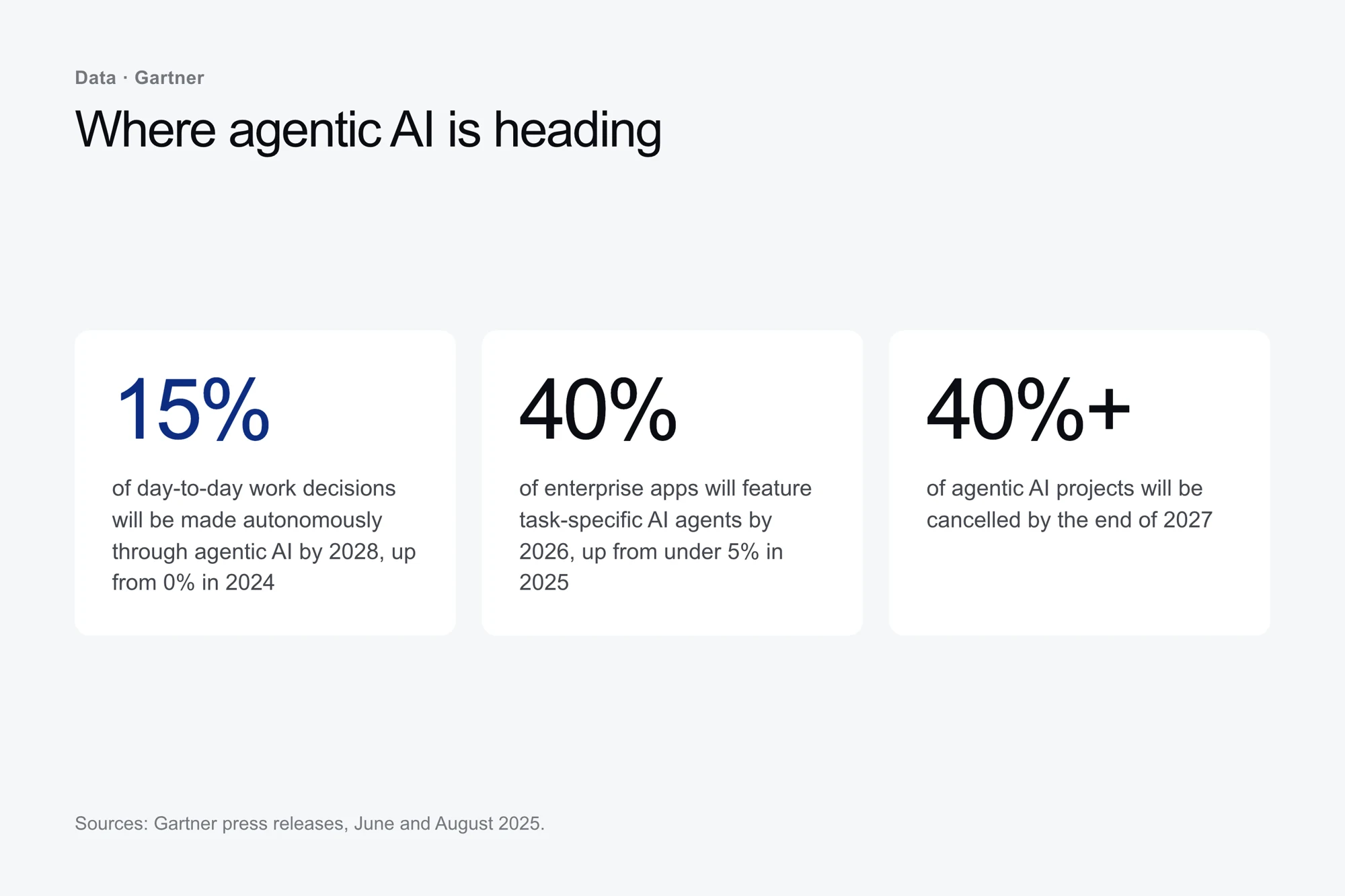
For a company, this means agentic AI will arrive inside the software you already use, whether you plan for it or not. Getting value from it means applying it to a specific process, with clear rules and measured results. Buying a generic promise tends to end up in that 40% of cancelled projects.
Common mistakes with agentic AI
Confusing a demo with a production system. Something working in a presentation doesn’t mean it survives everyday exceptions. Ask to see it with your real cases.
Buying “agents” that aren’t. Gartner calls it agent washing: selling chatbots or automations as agents under another name. Ask exactly what it does, in which tools and who approves what.
Granting autonomy before having data. Without a measured baseline, there’s no way to know whether the system improves anything or when it can work on its own.
Starting with the whole company. Start with one process. Expand once it works.
How to start with agentic AI
- Pick a process that matters, can be reached and can be checked. Repetitive, frequent and with a measurable before and after.
- Measure how it’s done today. Minutes, errors and corrections, on real cases.
- Run a scoped pilot with human approval on what matters.
- Scale only what proves itself, and grant more autonomy where the data justifies it.
We explain it in more detail in how we work and in our AI agents for companies service.
Frequently asked questions about agentic AI
Is agentic AI the same as an AI agent? They’re closely related. An AI agent is the concrete piece that does a task; agentic AI is the approach of building systems that act, often with several coordinated agents. We cover it in depth in what an AI agent is.
Does agentic AI replace generative AI? No, it uses it. The language model still understands and writes; agentic AI adds the ability to plan, use tools and complete tasks.
Is it safe for a company? It depends on the design. With limited permissions, a log of everything it does, human approval on what matters and a pause button, the risk is controlled. Without them, it isn’t.
Do I have to change my tools? No. An agentic system works inside what you already use: email, CRM, invoicing software or even spreadsheets.
Is it for small companies? Yes, if there’s a repetitive process eating hours. The volume of repeated work counts for more than company size.
Where to start
If you have a process that repeats every day and someone loses hours to it, tell us your case. In thirty minutes we walk through a real example and, if it’s worth it, prepare a proposal within two days with what to improve first, with which solution and at what cost.
Prefer to write? info@solventus.ai